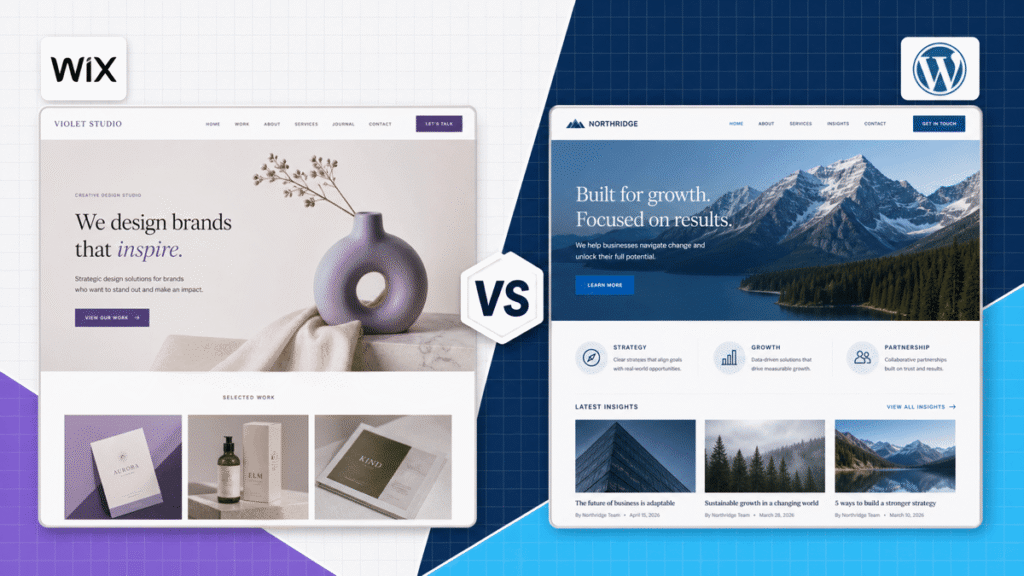
Wix and WordPress can both produce a professional website. The real difference is what happens behind the page you design.
Wix gives you the editor, hosting, maintenance, and support in one managed system. WordPress asks you to assemble a few pieces, but it gives you much more control over where the site lives, what it can become, and how easily you can move it.
My quick recommendation: choose Wix when your top priority is getting a straightforward website online with the technical work handled for you. Choose WordPress when the website needs to become a long-term business asset, content engine, or platform you fully control.
This video walks through the same decision across the major website builders. I compare the editing experience, ownership, apps, SEO, and the kinds of sites each platform handles best.
Wix vs WordPress at a glance
Here is the shortest useful version of the comparison. Wix wins on convenience. WordPress wins on ownership and range.
| My pick WordPress | Wix | |
|---|---|---|
| Best for | A website you want to own, expand, and move | A fast, managed, all-in-one website |
| Setup | More steps | Simpler |
| Hosting and maintenance | You choose the host and manage the site | Included and managed by Wix |
| Design freedom | Very high | High |
| Apps and extensions | Large plugin and theme ecosystem | Curated Wix App Market |
| Content and SEO growth | Best long-term fit | Good |
| Portability | Host and content can move | Site stays on Wix |
| My recommendation | Choose it for control and growth | Choose it for convenience |
Swipe to compare more options. WordPress stays pinned.
WordPress is my default recommendation for a serious long-term website. Wix is the easier choice when you want the platform to handle the technical side.
If you are comparing more than these two platforms, start with our website builder comparison. It puts Wix, WordPress, Squarespace, Shopify, and the other major choices into the same decision.
Choose for the site you will have two years from now. A platform that feels one step easier today can become the harder option if the site eventually needs hundreds of articles, specialized integrations, or a move to different hosting.
The main difference: a managed platform vs an open website system
Wix is a hosted website builder. You create an account, choose a plan, build with Wix's tools, and publish to Wix's infrastructure. The company handles hosting, platform updates, security at the service level, and the connection between its editor and apps.
WordPress is open-source website software. In this comparison, I mean self-hosted WordPress from WordPress.org, not the separate WordPress.com service. You install WordPress on a hosting account and choose the theme, editor, plugins, backups, and performance setup.
If that distinction is new, read what WordPress is and how it works. It explains how WordPress, a host, a theme, and plugins fit together.
What Wix takes off your plate
- Hosting: the site runs on Wix without a separate hosting account.
- Platform maintenance: Wix manages its core software and infrastructure.
- Integrated tools: the editor, templates, forms, analytics, apps, and support share one system.
- A controlled environment: apps and features are designed around the same platform.
That is a strong trade when you do not want to think about the website's technical foundation. You can concentrate on the pages, copy, images, forms, and business.
What WordPress puts in your hands
- Hosting choice: you can select a host for price, support, speed, or a specific technical need.
- Full extensibility: themes and plugins can change the design, editing workflow, data, and functionality.
- Site files and database: you can back them up, access them, and move them.
- Maintenance decisions: you decide when and how updates, backups, security, and optimization happen.
More control is not automatically better. It is better when you will use it. A five-page local service website may never need a custom content system or a server move. A publisher, growing company, membership, or complex store is more likely to value those options.
Which one is easier to build with?
Wix is easier to start. You can choose a template, answer a few setup questions, add pages, connect business features, and publish without first learning what a host or plugin is. The plan includes the system the editor expects.
Its visual editor also gives you a lot of freedom. That freedom is useful, but it creates one beginner trap: an element can look great on a wide monitor and awkward on a smaller screen. Check the tablet and mobile layouts as you build instead of leaving responsive work until launch day.
WordPress has a steeper first hour because you choose hosting, install the software, select a theme, and decide how to edit pages. Once that foundation is in place, a visual builder can feel familiar. You add sections, drag in elements, edit text on the page, and control the phone layout.
Here is what visual editing looks like inside Elementor on WordPress. The words can be edited directly on the page while the settings panel controls the design.
Our WordPress tutorial for beginners covers the full dashboard and site-building workflow. If you want to see the page editor by itself, use the Elementor tutorial.
Ease has two versions: Wix is easier to begin and easier to maintain. WordPress can be easier to change later because you are not limited to one platform's editor, app market, or hosting.
Design, templates, and editing freedom
Both platforms can build the standard website types: a service business, portfolio, blog, restaurant, event site, landing page, or store. Neither one makes a site professional by itself. The result still depends on hierarchy, spacing, type, images, and clear calls to action.
Designing with Wix
Wix gives you a large template library and a flexible visual canvas. It is especially appealing when you want an expressive layout without adding a separate page builder. The platform also connects common business features such as bookings, events, forms, payments, and marketing tools through its own ecosystem.
The advantage is that the pieces are designed to live together. The limit is that your design and functionality remain tied to Wix. You can own the content and domain while still depending on Wix to run the actual site.
Designing with WordPress
WordPress separates the content system from the design layer. A theme controls the broad visual foundation, and the block editor or a page builder controls the individual pages. That gives you an enormous range of starting points, but it also means you need to choose a combination that will stay maintainable.
I normally recommend one lightweight theme, one primary page-building system, and as few plugins as the site genuinely needs. A starter template can import the page structure, fonts, colors, and demo layout before you replace it with your own brand.
Here is the WordPress Starter Templates library filtered for Elementor. This is the kind of complete-site starting point I use instead of building every page from a blank canvas.
The website design guide shows how to turn a template into a site that looks intentional instead of leaving it full of demo content.
Apps, plugins, and custom features
Wix has an app market for adding functions such as forms, bookings, reviews, chat, events, memberships, marketing, and ecommerce tools. The selection is smaller and more controlled than WordPress, which can be an advantage for a beginner. There are fewer competing ways to solve the same problem.
WordPress has a much larger extension ecosystem. Plugins can add contact forms, ecommerce, memberships, courses, directories, multilingual content, custom fields, analytics, search tools, backups, security, and nearly every other common website feature.
That range is one of WordPress's greatest strengths and one of its most common failure points. Plugins can overlap, slow the site down, or fall out of maintenance. Use established tools, remove anything unused, and test updates on a backup.
Installing a plugin is simple inside the WordPress dashboard. The harder part is deciding whether the site needs it and whether it will still be a good choice a year from now.
Start with our recommended WordPress plugins instead of installing the first result for every feature.
SEO and content: both can rank, but WordPress has more room
Wix has the SEO fundamentals a normal business site needs. You can edit page titles and descriptions, control URL settings, add redirects and structured data, manage indexing, connect search tools, and publish a blog. The old blanket claim that Wix cannot handle SEO is not a useful way to make this decision.
WordPress is still my choice when organic search and publishing are central to the business. Its content model was built around posts, pages, categories, authors, archives, and custom content. SEO plugins, internal-linking tools, editorial workflows, custom fields, and performance controls give a larger site more ways to organize and improve the work.
WordPress also makes it easier to change the technical setup when the site outgrows its current one. You can move to a different host, replace the caching layer, change the theme, or rebuild the front end while keeping the underlying content.
None of that replaces useful writing. Search engines do not reward a platform logo. They reward pages that answer the query, load well, make sense on a phone, earn trust, and connect naturally to the rest of the site.
Ecommerce: choose around the store, not the homepage
Wix can run a good small-to-midsize store while keeping the website, products, checkout, and marketing tools in one managed account. It is appealing when the catalog is straightforward and you want to avoid maintaining a separate commerce stack.
WordPress usually pairs with WooCommerce. It offers much more control over product data, checkout behavior, subscriptions, shipping, payments, memberships, and integrations. That flexibility also means more extensions, more testing, and more responsibility for performance and maintenance.
If the store is the entire business, do not choose a platform based only on which homepage editor you like. Map the products, variants, subscriptions, taxes, shipping, inventory, international needs, and integrations first. Then compare Wix and WooCommerce with a commerce-first platform such as Shopify.
Our online store guide walks through that decision before you start loading products.
Cost: compare the complete setup
Wix charges for a bundled service. The plan covers the builder and hosting, with different levels for storage, collaborators, marketing, payments, and business features. The exact offer can vary by plan and location, so compare the current features you need rather than choosing from one promotional number.
WordPress software is free, but a working site is not. You need a domain and hosting. You may also pay for a theme, page builder, plugins, backups, maintenance, or expert help. A lean WordPress site can be inexpensive. A complex site with several premium systems can cost considerably more.
The useful question is not, “Which one has the cheapest entry plan?” Ask what the full site will cost for the next year, including the features, support, maintenance, and any help you will need.
A practical way to compare the bill
- Wix: plan, domain renewal, premium apps, business email, and any outside design or content help.
- WordPress: hosting, domain renewal, premium theme or builder, paid plugins, maintenance, and outside help.
- Either platform: photography, copywriting, email marketing, analytics, advertising, and staff time.
Ownership and moving the website later
This is the part of the comparison I would not skip. A Wix website has to run on Wix's platform. You can connect a domain you control and you own the content you upload, but the complete site is built on Wix's proprietary architecture and cannot simply be hosted somewhere else.
Moving from Wix normally means exporting the content that can be exported, saving the assets and data you need, and rebuilding the design on the next platform. That may be completely acceptable for a small site. It becomes a larger project when the site has years of content, products, members, or custom workflows.
A WordPress site is more portable. WordPress has export tools for content, and a full backup can include the database, media, themes, and plugins. A migration may still require technical work, but the platform is not tied to one hosting company.
My long-term pick
Building with WordPress
Why I recommend it
- You control the website You choose the host, theme, plugins, files, and database instead of building inside one company's closed system.
- It can grow in almost any direction A simple brochure site can become a deep content library, membership, course platform, directory, or store.
- It is built for publishing Posts, categories, archives, authors, custom content types, and editorial workflows give content room to scale.
- You can move it WordPress content and databases can be exported, backed up, and transferred to another compatible host.
What you take responsibility for
- There are more setup decisions You need hosting, a domain, a theme, and a sensible plugin stack before the site feels complete.
- Maintenance belongs to you WordPress core, themes, plugins, backups, security, and performance need regular attention.
- Too many options can create a mess A pile of overlapping plugins and design tools makes the site slower and harder to maintain.
Who should choose Wix?
Choose Wix when most of these sound like you:
- You want the editor, hosting, security, updates, and support under one account.
- You are building a brochure site, portfolio, restaurant site, event site, or straightforward service business.
- You want built-in business apps without researching a separate plugin stack.
- You would rather accept platform limits than manage website infrastructure.
- You do not expect to move the complete site to another host.
Wix is not the consolation prize in that situation. A tool that removes work you do not want can be the right professional choice.
Before you commit, list every feature the site needs and confirm that the Wix plan and apps cover it. Pay special attention to bookings, memberships, product rules, multilingual content, and outside integrations.
Who should choose WordPress?
Choose WordPress when most of these sound like you:
- The website will publish a large or growing library of useful content.
- You want full control over hosting, themes, plugins, files, and the database.
- You expect custom features, complex integrations, memberships, courses, directories, or an expandable store.
- You want the option to change hosts or rebuild the design without leaving the content system.
- You are willing to maintain the software or pay someone to maintain it.
For most serious business websites, WordPress is still my default recommendation. The learning curve is a little higher, but you are building on a foundation that can change with the business.
If that is your choice, follow the step-by-step website guide. It covers the domain, hosting, WordPress setup, template, pages, and launch in the right order.
Do not choose WordPress for “unlimited possibilities” and then install unlimited tools. Pick one theme system, one page-building approach, and a small plugin stack. Control is valuable when the setup stays understandable.
Wix vs WordPress FAQ
These are the questions that usually decide the choice once the basic differences are clear.
Frequently Asked Questions
Is Wix or WordPress better for beginners?
Wix is easier on day one because hosting, security, updates, templates, and the visual editor live in one account. WordPress takes a few more setup decisions, but a good host, a lightweight theme, and one page builder make it very manageable. Choose Wix for the shortest path to a basic site. Choose WordPress if you are willing to learn a little more for greater control.
Is Wix or WordPress better for SEO?
Both can support the technical basics of SEO. Wix includes tools for titles, descriptions, redirects, structured data, sitemaps, and search integrations. WordPress gives you more control over content structure, plugins, custom fields, performance, and large publishing workflows. For a site where search traffic and content are central to the business, I prefer WordPress. Our WordPress blog guide shows that workflow.
Can I move a Wix website to WordPress later?
You can move the content and rebuild the design, but you cannot pick up the complete Wix site and host it somewhere else. Wix sites use Wix's proprietary platform. If you expect a future move, plan for a manual rebuild and keep clean copies of your text, images, product data, contacts, and domain records.
Do I need separate web hosting with Wix?
No. Hosting is part of the Wix platform, and a paid plan connects your own domain. With self-hosted WordPress, you choose and pay for a separate host. That extra decision is also what lets you change hosting companies later.
Is Wix or WordPress better for a small business?
Wix is a good fit for a small service business that wants a polished brochure site, booking tools, forms, and minimal maintenance. WordPress is the stronger fit when the website will be a major business asset with landing pages, detailed services, ongoing articles, integrations, or custom features. The business website guide maps the pages either platform needs.
Is Wix or WordPress better for an online store?
Wix works well for a smaller catalog when you want the storefront and website in one managed system. WordPress with WooCommerce gives you more control and a wider extension ecosystem, but it also creates more maintenance. If selling is the entire business, compare those choices with dedicated commerce platforms in our online store guide.
Which platform is cheaper?
It depends on what the site needs. Wix bundles the editor, hosting, security, and support into its plans. WordPress itself is free, but hosting, premium themes, plugins, maintenance, or developer help can add to the cost. Compare the complete annual setup, not the lowest advertised entry price.
Can I use my own domain with Wix and WordPress?
Yes. A paid Wix plan can connect a custom domain. A self-hosted WordPress site also uses your own domain through the host or domain registrar. Keep the domain registered in an account you control, regardless of the platform.
The final choice
Choose Wix if you want a capable all-in-one platform and would rather have one company manage the technical foundation. It is the faster route to a straightforward website, and its current design, business, and SEO tools are strong enough for many small businesses and personal projects.
Choose WordPress if the website needs to be owned, moved, extended, or built into a serious content and business asset. It asks more from you at the beginning and throughout maintenance, but it gives you far more freedom over what happens next.
My pick for long-term growth is WordPress. My pick for the person who wants to build once, keep the technical decisions small, and get back to running the business is Wix. The better choice is the one whose tradeoffs match the job.
Still comparing? Use the broader best website builders guide, then use the step-by-step website guide when you are ready to build.
For the record: It’s super important for us to keep this site 100% free for you and 100% high quality. To help us do that, we’ve partnered with some of the products we recommend and earn a commission if you buy through our links. Read our full disclosure and partners list here.