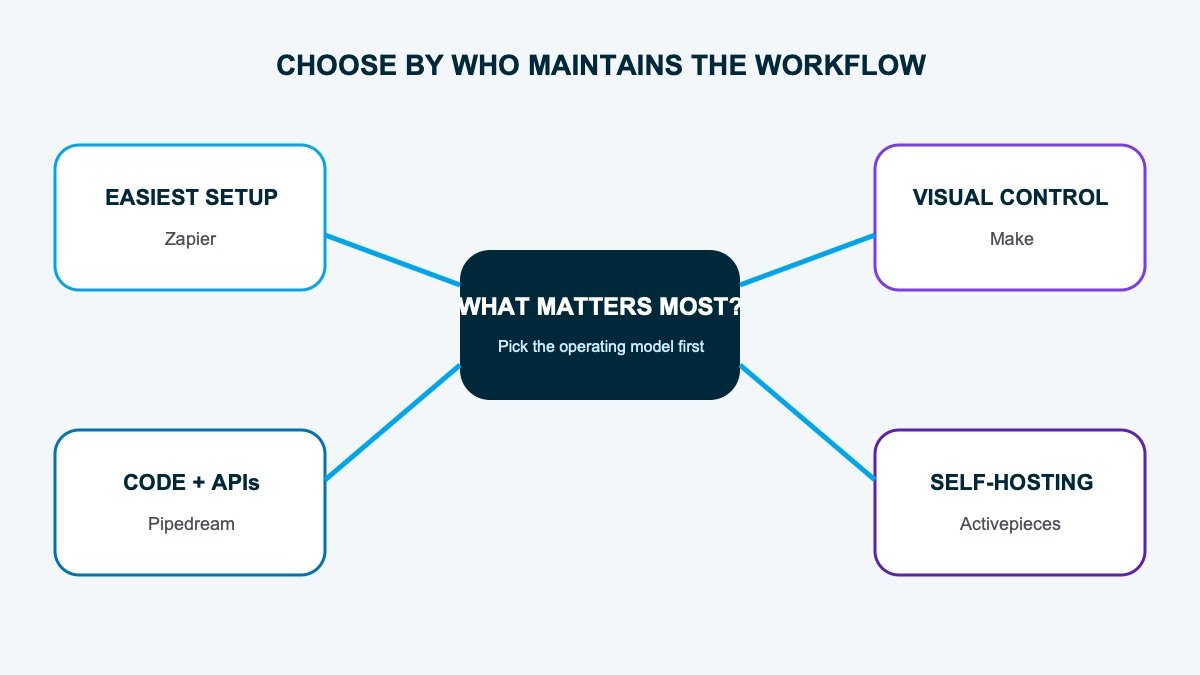
The best n8n alternative depends on why n8n feels wrong for you. Choose Zapier when you want the easiest setup and widest app coverage, Make when you want a visual builder with more control, Pipedream when developers want code and managed infrastructure, Activepieces when self-hosting matters, and Node-RED when you're automating devices or event-driven systems.
n8n is powerful because it sits between no-code automation and custom development. That middle ground is also why it can feel like too much tool for a simple job. This guide compares the real trade-offs so you can switch for a reason, not because another homepage looks cleaner.
Quick answer: Zapier is the easiest n8n alternative for business users. Make is the best visual alternative for complex branching. Pipedream is the strongest developer-first option. Activepieces is the simplest open-source alternative to evaluate for self-hosting.
Why look for an n8n alternative?
n8n gives you a visual workflow canvas, code nodes, webhooks, AI integrations, and a self-hosted Community Edition. It can handle serious automation. But a tool can be capable and still be the wrong fit for your team.
- The learning curve is slowing you down. Nontechnical teammates may struggle with data mapping, expressions, credentials, and error handling.
- You don't want to operate a server. Self-hosting gives control, but it also gives you updates, backups, security, uptime, and scaling.
- Your app isn't well supported. A platform with a larger connector catalog may save weeks of API work.
- Pricing doesn't match your workload. Platforms bill by tasks, operations, executions, compute, or seats. The same workflow can cost very different amounts.
- You need stronger governance. Permissions, audit logs, environments, approvals, and support may matter more than raw flexibility.
n8n alternatives at a glance
The product boundaries below were checked against the official pages for Zapier, Make, Pipedream, Activepieces, Node-RED, Power Automate, and OpenClaw. Recheck pricing and integration counts on those first-party pages before switching a production workflow.
Start with the operating model, not the feature list. The table below compares who each platform is for and what tradeoff you accept.
| Tool | Best for | Big advantage | Main trade-off |
|---|---|---|---|
| Zapier | Fast business automations | Huge app ecosystem and gentle learning curve | Complex, high-volume workflows can get expensive |
| Make | Visual multi-step workflows | Excellent branching and data visibility | Scenarios still take time to master |
| Pipedream | Developers and API workflows | Code plus managed infrastructure | Less approachable for nontechnical teams |
| Activepieces | Accessible open-source automation | Self-hosting with a simpler feel | Smaller ecosystem than the biggest platforms |
| Node-RED | IoT and event-driven systems | Lightweight, flexible flow programming | Not designed as a polished SaaS automation suite |
| Power Automate | Microsoft 365 organizations | Deep Microsoft ecosystem integration | Licensing and environment management can be confusing |
| OpenClaw | Agent-led personal workflows | Natural-language goals across tools and channels | Less deterministic than a fixed workflow graph |
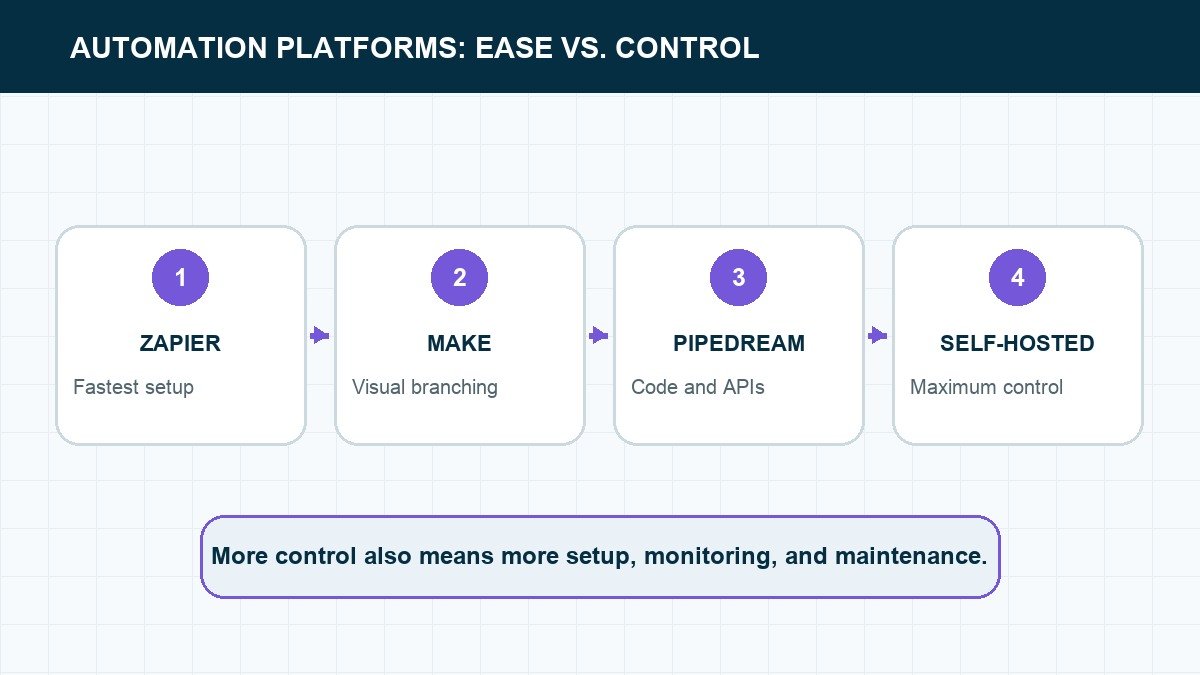
The first decision is how much technical control the workflow really needs. A simple trigger and action usually benefits from guardrails. Branching logic, custom code, and unusual data handling need more room.
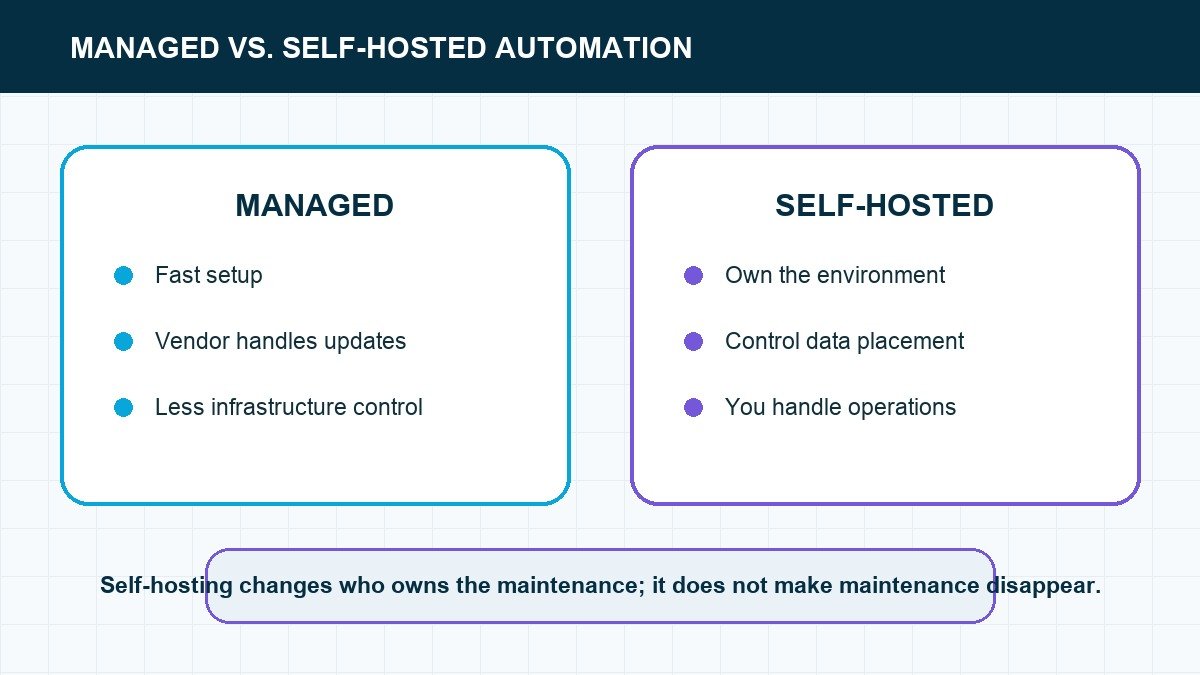
The second decision is ownership. Self-hosting can improve control and data placement, but it also makes updates, monitoring, backups, and incident recovery your job.
If you want the automation to make judgment calls inside a conversation, see our practical OpenClaw use cases. If the work is deterministic, keep it in a workflow tool until an agent clearly improves the result.
1. Zapier: best for getting a workflow live fast
Zapier is the obvious alternative when the team wants to connect common business apps without learning how APIs work. Its biggest advantage is coverage. Zapier currently advertises connections to more than 9,000 tools, which makes it likely that your CRM, form builder, email platform, and project manager already have maintained actions.
The builder is designed around triggers and actions. That makes simple flows easy to explain: when a form arrives, create a lead, notify sales, and send a confirmation. Zapier has added tables, interfaces, AI agents, and more advanced logic, but its center of gravity is still quick SaaS automation.
Choose Zapier if: nontechnical teammates own the workflows, connector coverage matters most, and speed is worth paying for. Skip it if you're running huge execution volumes or need deep control over every transformation.
2. Make: best visual alternative to n8n
Make is the closest fit for someone who likes n8n's canvas but wants a managed, visual-first platform. Scenarios show modules, branches, filters, iterators, and data movement directly on the screen. When a workflow fails, you can inspect what entered and left each module.
Make says it connects more than 3,000 pre-built apps and also supports custom apps, HTTP requests, webhooks, JavaScript, and Python. That gives it more depth than a basic trigger-action tool while keeping the workflow visible to a nondeveloper.
Choose Make if: your automations branch, transform lots of data, or need a canvas the whole team can discuss. Skip it if even a visual scenario feels too technical for the people maintaining it.
3. Pipedream: best for developers who don't want servers
Pipedream combines event sources, managed execution, prebuilt app actions, and code steps. A developer can start with a webhook, transform the payload in JavaScript or Python, call an API, and let Pipedream handle the infrastructure around that workflow.
This is a strong escape hatch from self-hosted n8n. You keep the freedom to write code without maintaining the runtime, queue, updates, and deployment process yourself. The trade-off is obvious: a marketing or operations teammate may find a code-first workflow harder to own.
Choose Pipedream if: developers build the workflows, APIs are central, and managed infrastructure is the reason you're leaving n8n.
4. Activepieces: best simpler open-source alternative
Activepieces targets the same broad problem as n8n: connect apps through visual flows, with cloud and self-hosted options. Its interface is intentionally approachable, which makes it worth testing when n8n feels heavier than your workflows require.
The key question is connector coverage. A smaller open-source ecosystem can be perfectly adequate if it supports your ten core apps. It becomes painful if every new workflow starts with building a custom piece.
Choose Activepieces if: you want open-source control, a cleaner starting experience, and have already confirmed the integrations you need.
5. Node-RED: best for devices and event-driven flows
Node-RED is a flow-based programming tool originally built around connecting hardware devices, APIs, and online services. It runs on lightweight hardware and has a large community node ecosystem, which is why it remains popular for IoT, home automation, industrial prototypes, and local event processing.
It can automate business systems, but that's not where it feels most polished. You won't get the same managed connector experience, collaboration layer, or business-user onboarding as Zapier or Make.
Choose Node-RED if: local devices, MQTT, sensors, or lightweight edge workflows matter more than a glossy SaaS interface.
6. Microsoft Power Automate: best for Microsoft-heavy teams
If your organization already lives in Outlook, Teams, SharePoint, Excel, Dynamics, and Azure, Power Automate deserves a serious look. Its advantage isn't that it is universally easier than n8n. Its advantage is that identity, permissions, data, and business processes already live inside the same Microsoft environment.
Power Automate includes cloud flows, desktop automation, approvals, and deep enterprise controls. Licensing and environment setup can become complicated, so involve whoever manages Microsoft 365 before building a business-critical process.
Choose Power Automate if: Microsoft is already the center of your company and governance matters more than tool independence.
7. OpenClaw: best for agent-led personal automation
OpenClaw isn't a direct clone of n8n. Instead of defining every branch in a workflow graph, you give an agent tools, instructions, and a goal. The agent can work through chat channels, browse, handle files, run approved commands, and schedule tasks through its Gateway.
That makes it interesting for fuzzy personal workflows such as “read my active project notes and build tomorrow's brief.” It makes it less appropriate for processes where the same input must always follow the same audited path.
Choose OpenClaw if: natural-language requests and personal context matter more than deterministic business process automation. Read our OpenClaw use cases before deciding whether agent behavior fits the job.
How to choose the right n8n alternative
- List your real workflows. Use the five automations you run most, not an imaginary future roadmap.
- Count billable units. Map tasks, operations, executions, compute, and seats against your actual volume.
- Check every critical connector. “Thousands of apps” means nothing if your accounting system is missing.
- Rebuild one difficult workflow. A simple lead notification won't reveal how the platform handles loops, errors, and data transformations.
- Choose the maintainer. The right tool for a developer is often the wrong tool for an operations manager.
- Plan the exit. Document credentials, logic, ownership, and exported workflow definitions where available.
My practical pick: choose Zapier for simplicity, Make for visual control, Pipedream for code, and Activepieces for an open-source trial. Stay with n8n if you actually use its mix of self-hosting, visual flows, and code. Switching tools won't simplify a workflow that was poorly designed in the first place.
The best alternative is the one your team can operate after the person who built the first workflow is unavailable.
Frequently Asked Questions
What is the easiest alternative to n8n?
Zapier is usually the easiest for common business apps and straightforward trigger-action workflows. Its interface, templates, and connector coverage reduce setup time. Make is more visual and flexible, but it asks the user to understand data flow more deeply.
Is there a free n8n alternative?
Several alternatives offer free cloud tiers or self-hosted editions, including Activepieces and Node-RED. “Free” still may require hosting, maintenance, or usage limits. Compare the complete operating cost, not only the subscription line.
Which n8n alternative is best for self-hosting?
Activepieces is the clearest place to start if you want a modern visual automation tool with self-hosting. Node-RED is excellent for local, device, and event-driven workflows. n8n itself may still have the more mature fit if your current self-hosted setup works.
Is Make better than n8n?
Make is better for teams that want managed hosting and a visual workflow they can inspect together. n8n is better when self-hosting, custom code, and infrastructure control matter. Rebuild your hardest representative workflow in both before choosing.
Is Zapier better than n8n?
Zapier is easier and connects more ready-made apps. n8n gives technical users more control and a self-hosted path. The better choice depends on who maintains the workflow and how complex or high-volume it is.
What is the best n8n alternative for developers?
Pipedream is the strongest managed developer-first option because it combines events, app actions, and code without asking you to operate the workflow infrastructure. Node-RED is stronger when the flow needs to run locally or connect to devices.
Don't switch until the hard workflow passes
A platform demo can make every automation look easy. The real test is the workflow with branching, messy data, rate limits, retries, and the one obscure app your company cannot replace.
Build that workflow during the trial. If the alternative handles it cleanly and the future maintainer can understand it, switch. If the real choice is between a fixed flow and a conversational agent, compare the operating models in our OpenClaw alternatives guide. If neither test passes, keeping n8n and simplifying the workflow may be the better move.